What Is an Agentic PDLC? How AI Agents Work Across the Product Development Lifecycle
Definition An agentic PDLC (agentic product development lifecycle) is a way of building software products in which specialized AI agents plan and carry out work at every stage, from discovery and requirements to release and post-launch learning. An orchestration layer coordinates the agents, a shared memory keeps context, and people approve the decisions that carry…
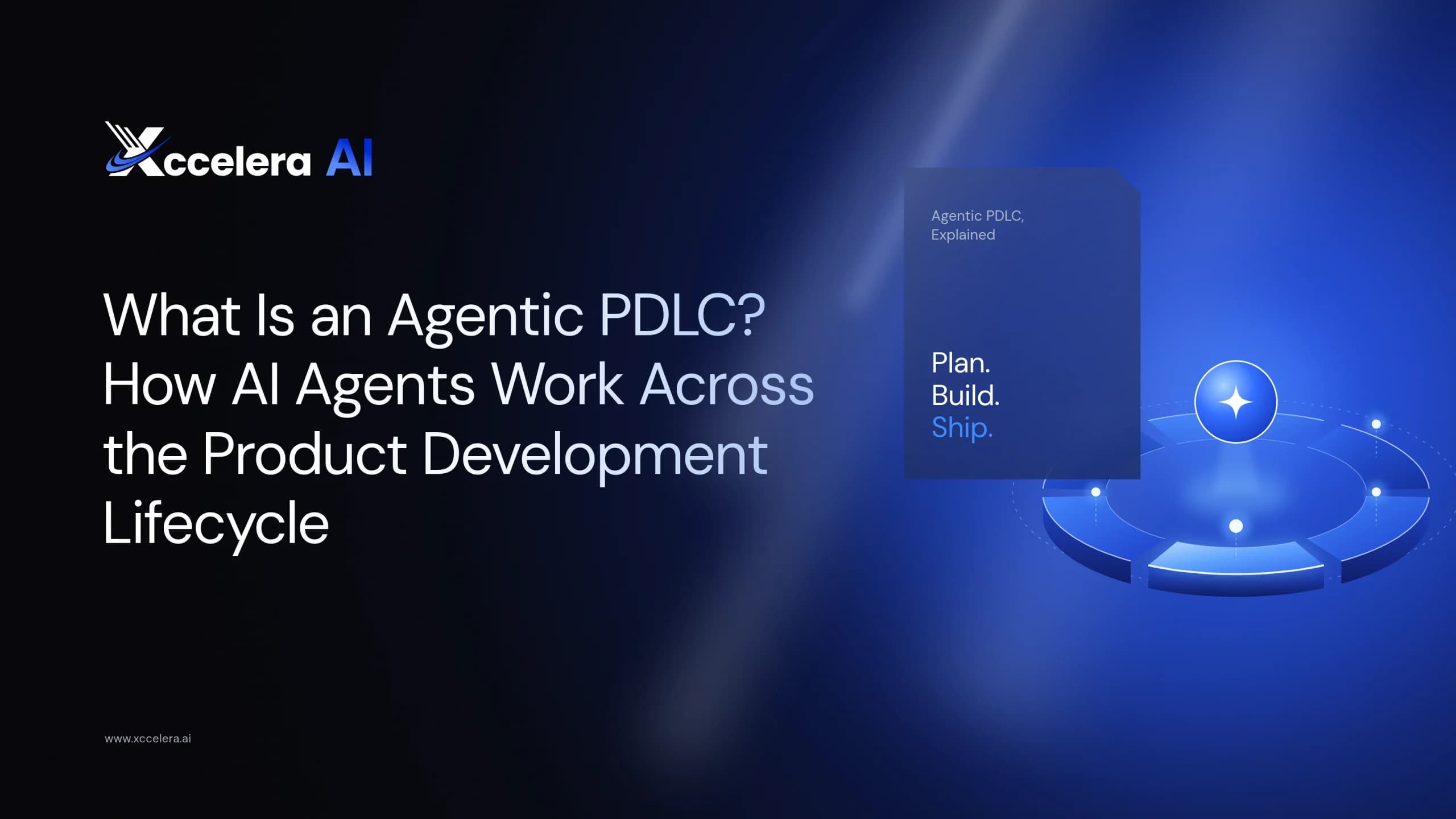
An agentic PDLC (agentic product development lifecycle) is a way of building software products in which specialized AI agents plan and carry out work at every stage, from discovery and requirements to release and post-launch learning. An orchestration layer coordinates the agents, a shared memory keeps context, and people approve the decisions that carry risk.
Most product teams now use AI somewhere, but few have redesigned how they build products around it. McKinsey’s August 2026 research on agentic product development projects that investment in agentic software development will grow more than twelvefold from 2025 to 2026. Yet only one in four companies said these tools had meaningfully sped up their product development lifecycle.
Projected growth in agentic software development investment, 2025 to 2026
Companies that report meaningful acceleration of their PDLC
Companies where productivity fell after teams adopted agentic AI
Source: McKinsey, Beyond the copilot (August 2026), as reported by CIO Dive.
So the tools alone are not the answer. According to McKinsey, leaders stand out because they redesign workflows, roles and controls around the agents. This guide explains what that means, how AI agents work at each stage and what the architecture underneath looks like.
What Is an Agentic PDLC?
In short, the product development lifecycle covers everything from spotting an opportunity to learning from a live product. In a traditional PDLC, people carry each piece of work through every stage. As a result, most of the waiting happens at the handoffs between teams.
An agentic PDLC changes the unit of work. Instead of helping one person with one task, specialized agents take a goal and move it through discovery, requirements, design, build, test and release. They work in parallel and around the clock, so work no longer sits in a queue for the next team. Meanwhile, people set direction, approve key decisions and judge whether the product is right.
If you are new to the wider shift, our overview of why enterprises are moving to agentic AI is a good starting point.
PDLC vs SDLC: What’s the Difference?
The software development lifecycle (SDLC) is the build-and-ship part of the PDLC. It covers requirements, design, development, testing and release. The PDLC adds the product work on either side, namely discovery before the build and adoption, feedback and iteration after launch.
That difference also matters for agents. An agentic SDLC speeds up delivery, while an agentic PDLC also improves what the team delivers. For a closer look at the build phase alone, see what an agentic SDLC looks like, stage by stage.
How Is an Agentic PDLC Different From AI-Assisted Development?
Most teams move through three models over time. The main difference between them is who carries the work from one step to the next, because that is where most of the time goes.
Traditional PDLC
Agent autonomy: none
AI-assisted
Agent autonomy: single tasks
Agentic PDLC
Agent autonomy: multi-step, with checkpoints
From Linear Handoffs to Parallel Work
The biggest change is in flow. In a linear process, each stage starts when the previous one ends. In an agentic PDLC, by contrast, testing runs while agents write code, and post-launch learning feeds the next discovery cycle. Switch between the two views to compare them.
McKinsey senior partner Martin Harrysson describes the shift as a move toward “smaller, highly leveraged teams that supervise agents through execution.” In other words, people spend less time moving work along and more time deciding where it should go.
How Do AI Agents Work at Each Stage of the PDLC?
Each stage has its own agent, inputs, outputs and human checkpoint. Select a stage to see how it works.
Stage 1: Discover and Prioritize
The insight agent pulls customer feedback, support tickets, usage data and market signals into one view. Then it groups them into opportunity briefs with the evidence attached, so product managers spend less time collecting data and more time deciding.
Stage 2: Define Requirements
The requirements agent turns business input into user stories, acceptance criteria and edge cases. It also checks them against existing systems for conflicts. These criteria then drive every later stage, including test generation.
Stage 3: Design the Solution
First, the design agent proposes architecture options, API contracts, data models and UI flows that fit your standards. It also reuses proven patterns from earlier projects and flags trade-offs for the architect to decide.
Stage 4: Build
Development agents work in parallel against the approved design, each in its own area, while the orchestrator manages the dependencies between them. Teams that connect requirements and designs directly to code generation see the biggest gains here, as our look at going from requirement to TestFlight shows.
Stage 5: Test and Validate
The testing agent generates tests from the acceptance criteria while the build agents are still writing code. It then runs regression, security and dependency checks on every change. For more detail, our guide on how to verify AI-generated code explains each of these gates.
Stage 6: Release
The release agent prepares the deployment and checks that tests, security scans and compliance evidence are complete. It then produces a readiness report. Because the evidence already exists, deployments become routine.
Stage 7: Operate and Learn
These agents watch production, trace incidents to their cause and map what a fix will affect before anyone changes code. They also send usage patterns and issues back to discovery, which closes the loop.
What Does the Architecture of an Agentic PDLC Look Like?
Agents are the visible part. Underneath, the lifecycle needs a stack of shared layers, plus a control plane where people stay in charge.
Orchestration: The Coordinator
The orchestration layer breaks goals into tasks and assigns them to the right agents and models. It also tracks dependencies and decides when a person needs to step in. Without it, however, you end up with a set of fast but disconnected tools. We cover this layer in depth in why enterprise AI needs an orchestration layer.
Shared Memory: Why Agents Need a Knowledge Graph
Agents lose much of their value when every task starts from zero. A shared memory, often built as a knowledge graph, links requirements, decisions, code, tests, defects and releases. Therefore each agent starts with the full history of the product. It also keeps institutional knowledge in place when people move on.
Connectors and MCP: Access to Real Systems
Agents act through the tools your teams already use, such as Git, Jira, CI/CD pipelines, cloud platforms and CRM. A standard connector layer, often built on the Model Context Protocol (MCP), means you connect a tool once and every agent can use it.
Where Do People Stay in Control?
This model works because people keep the decisions that carry business, security or customer risk. Agents then run the work between four checkpoints.
Confirms the stories and acceptance criteria match the bet.
Approves architecture, contracts and trade-offs.
Reviews changes to auth, payments, data and infrastructure.
Checks the readiness report before release.
Roles shift as a result. Product managers spend more time on discovery and outcomes, and architects focus on standards and review. Engineers, meanwhile, supervise agents and handle exceptions. Our article on what happens when AI agents become part of the engineering operating model explores these role changes.
How Do You Move to an Agentic PDLC?
McKinsey’s research points to four factors that separate leaders: redesigned workflows, new roles, stronger controls and hands-on upskilling. For that reason, a phased path keeps the risk low.
Map one value stream
First, pick a product line, map every stage and handoff, and record a baseline for cycle time, rework and defects.
Start with an end-to-end slice
Run agents across requirements, build and test for a small feature set, so you see gains in flow and not just in one task.
Connect memory and systems
Add the knowledge graph and connectors, so agents work from real context and real tools.
Set gates and metrics
Then define the four checkpoints, what each approver checks and the metrics that prove progress.
Scale product by product
Finally, extend to more product lines, reuse agents and patterns, and keep tuning against the baseline.
For many teams, the path from requirements to tested code has the most waiting and rework. That makes it a good first slice, because the gains are easy to see and measure.
How We See It at Xccelera AI
The approach succeeds or fails on the system around the agents: orchestration, shared memory, connectors and clear human checkpoints. Otherwise, agents added one at a time mostly move the bottleneck somewhere else.
That is why Xccelera designed its agentic platform as one system. Specialized agents cover requirements, design, development, testing and release, and Xccelera Orchestrator coordinates them. A memory harness and knowledge graph carry context between projects, and more than 100 connectors link the agents to enterprise tools. Our platform-led software development service applies this to your products, with human approval at every critical step.
Frequently Asked Questions
What does PDLC stand for?
PDLC stands for product development lifecycle. It covers the full journey of a product, from discovery and requirements through design, build, testing and release to learning after launch.
Is an agentic PDLC the same as an agentic SDLC?
No. An agentic SDLC applies agents to building and shipping software. An agentic PDLC also includes the product work around it, such as discovery, prioritization and learning from users after launch.
Which stage should teams hand to agents first?
Start where handoffs cause the most waiting and rework. For many teams that is the path from requirements to tested code, because clear acceptance criteria let agents build and test in parallel.
Do AI agents replace product managers or engineers?
No. Instead, agents take on repeatable execution. Product managers still decide what to build, architects own the design, and engineers supervise agents and handle the exceptions.
How do you measure an agentic PDLC?
Track flow and quality across the whole lifecycle: time from signal to decision, lead time for changes, rework, escaped defects, change failure rate and time to restore service.
Building Products With an Agentic PDLC
Put simply, it turns the product lifecycle from a relay of handoffs into a coordinated system. Specialized agents carry the work, shared memory keeps the context and people make the calls that matter. The tools are widely available. However, the advantage goes to teams that redesign their lifecycle around them.
Which stage of your product lifecycle loses the most time to handoffs today? Tell us on LinkedIn. For more on agentic delivery, you can subscribe to the Xccelera newsletter.
Map Your Product Lifecycle With Agents
See where agents fit in your product lifecycle, where people stay in control and what to measure first.
Sunil Gupta is a Business Development Manager at Xccelera AI, where he helps enterprises adopt scalable AI solutions, including custom AI agents and agentic workflows. He has more than nine years of experience in business development across IT services and emerging technology. He holds a Master of Computer Applications in Information Technology from Dr. A.P.J. Abdul Kalam Technical University. Connect with Sunil on LinkedIn.
Xccelera AI is an agentic AI company that helps enterprises transform operations and accelerate engineering through its proprietary Xccelera AI Platform, a multi-agent system that spans the full software delivery lifecycle.