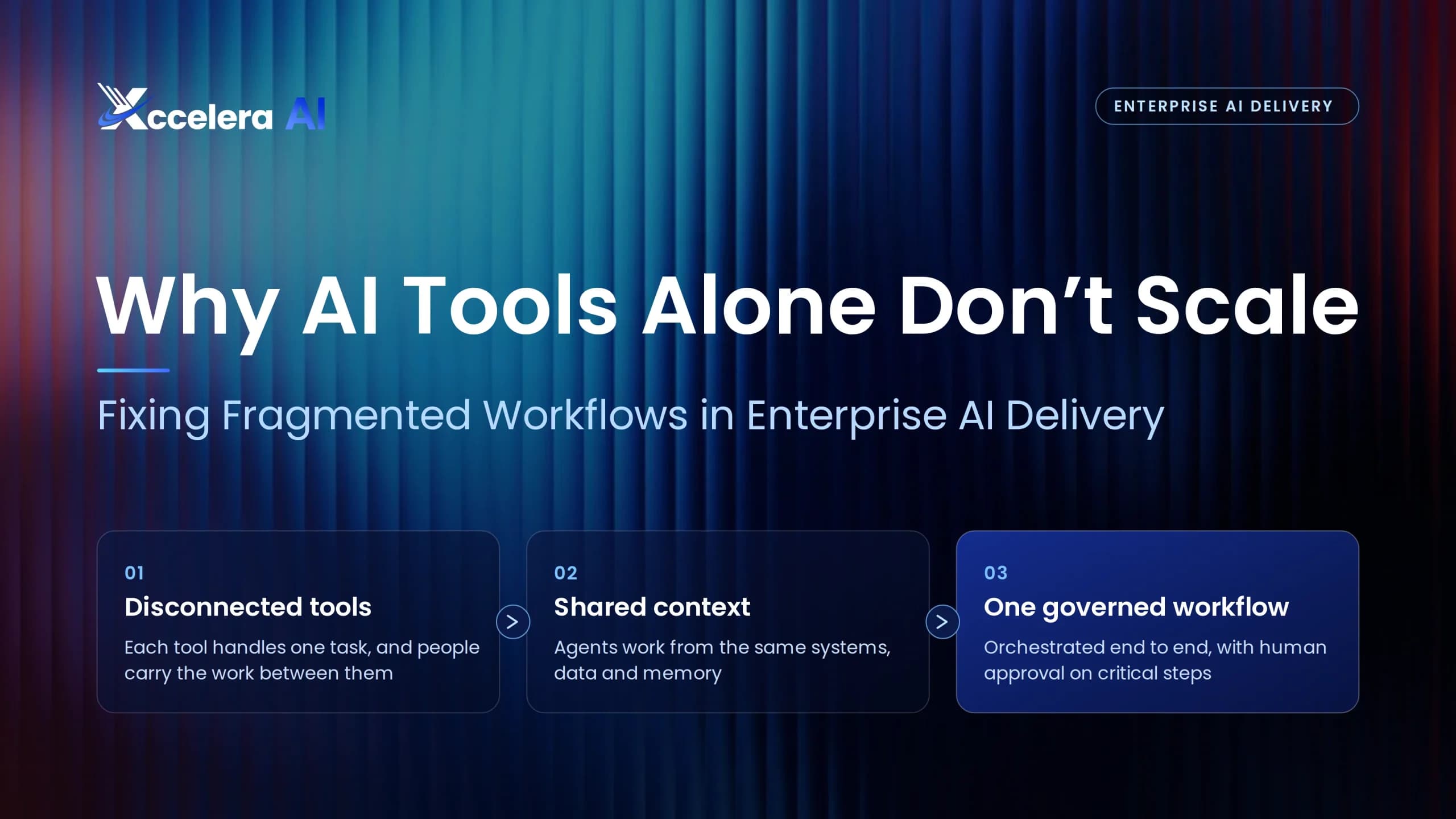
Why AI Tools Alone Don’t Scale: Fixing Fragmented Workflows in Enterprise AI Delivery
Enterprise AI delivery challenges come from the gaps between tools, not from the tools themselves. A point tool speeds up one task, but delivery speed depends on the whole flow of handoffs, context, reviews and approvals. In McKinsey’s 2026 survey, 80% said AI improved their personal productivity, yet only 37% saw any EBIT…
- Enterprise AI delivery challenges come from the gaps between tools, not from the tools themselves.
- A point tool speeds up one task, but delivery speed depends on the whole flow of handoffs, context, reviews and approvals.
- In McKinsey’s 2026 survey, 80% said AI improved their personal productivity, yet only 37% saw any EBIT impact.
- Scaling takes connected agents, shared context and human checkpoints, so map one feature’s handoffs before buying another tool.
Enterprise AI delivery challenges often start with a pattern most leaders will recognize. First, every team picks a favorite AI tool. Developers write code faster, analysts summarize faster, and testers draft cases faster. Nobody is exaggerating when they say it helps. Yet the release date has not moved.
That gap is the subject of this article. So we lean on four 2026 studies and one older experiment, then explain what we think closes it. If you want the pilot-to-scale angle first, our piece on why most enterprise AI pilots fail at scale is the best companion.
Faster for the Person, Flat for the Business
First, look at what the newest data says. In McKinsey’s State of AI survey, published in August 2026 with 1,719 respondents, 80% said AI had improved their personal productivity. But only 37% attributed any EBIT impact to AI, and that share is unchanged from last year. About 6% qualify as high performers.
Atlassian’s report, published in October, shows the same split inside engineering. Of the developers surveyed, 87% say AI helps them ship work faster. Yet 72% report the same or more friction than before AI arrived.
But both studies rely on self-reported answers, and Atlassian says so plainly. Still, the shape matches. People feel faster, but delivery does not, and that is the core of today’s enterprise AI delivery challenges.
Why Does a Faster Task Not Mean Faster Delivery?
Because delivery is a line, not a task. Work moves through planning, design, build, review and test, and it spends a surprising share of its life waiting between them. So when you speed up one station, you shorten one block of the clock, while the waiting stays exactly where it was.
Below is a made-up feature on three calendars. The numbers are illustrative, not measured. We made the waits long on purpose, because many teams find that is what they see when they first draw their own value stream. Open each one in turn.
1TodayThe baseline100
2With a point toolBuild is twice as fast94
3With a connected flowThe waiting shrinks53
What the Three Calendars Show
Now look at the second timeline. Build got twice as fast, but the whole line improved by only a few points. Part of that is the extra AI output landing in review, a pattern Atlassian also reports. Then look at the third. It changes the waiting instead of the working, and that is where the big gain sits.
DORA’s 2025 research puts the idea in one word: AI is an amplifier. It magnifies whatever delivery system it joins, strong or weak. As a result, a fragmented system gets a faster, more fragmented system. That is why enterprise AI delivery challenges so often look like tool problems and turn out to be system problems.
Where Do the Saved Hours Go?
Atlassian also asked developers how much time AI gives back. The share saving ten or more hours a week fell from 68% to about a quarter in a single year. However, the hours did not vanish. They moved.
So most of it goes to checking and managing. Also, the older friction is still there: finding information, meetings and context switching. So the saved time has plenty of places to leak.
There is also a perception problem. In METR’s 2025 randomized trial, experienced developers took 19% longer with AI tools on their own repositories, yet they believed they had been about 20% faster. METR’s 2026 follow-up could not settle how large today’s speed-up is. Still, the lesson is not that AI is slow. Instead, it is that feeling fast and delivering fast are different measurements.
Where Enterprise AI Delivery Challenges Really Live
Because time is lost between stations, look at how the stations connect. Salesforce’s 2026 Connectivity Benchmark surveyed 1,050 IT leaders. It found the average organization runs 957 applications, and only 27% of them are integrated.
Now add agents. More than four in five of those IT leaders expect agent sprawl to add more complexity than value, mostly because of integration gaps. That is the quiet cost of AI tool sprawl: every new tool is another island.
You can spot fragmented AI workflows without a survey, though. Look for these five tells.
The same context is typed twice
Spot itA developer pastes the same background into three different tools in one hour.
Every tool has its own “done”
Spot itA ticket closes in one system while the work is still open in another.
Approvals live in chat
Spot itNobody can say who approved last month’s change without scrolling.
Nobody knows which agent changed what
Spot itAn incident review starts with a search for the author.
People are the integration layer
Spot itSomeone’s weekly job is copying status between systems.
Score Your Own Fragmentation
Tap every statement that is true for your team today. It is a quick way to see how exposed you are to the enterprise AI delivery challenges above. The meter updates as you go, and nothing is stored or sent anywhere.
Our AI tools don’t share context, so people re-explain the same background.
A change can pass in one tool and fail in another.
We can’t say how many AI tools or agents run across teams.
Approvals live in chat or email, not in the workflow.
Someone copies status or data between systems by hand.
Review work on AI output is growing faster than our reviewers.
Each team picked its own AI tool with no shared plan for how work flows.
Finding which agent or person changed something takes more than a few minutes.
Nothing ticked yet. Be honest. The result is more useful that way.
Score 1 to 2: early signs. Fix these before they multiply, so pick one handoff and make it explicit.
Score 3 to 5: real fragmentation. Your tools are probably faster than your delivery. So start by mapping one feature end to end, using the ledger further down.
Score 6 to 8: severe. Another tool will likely add cost faster than value. Instead, connect the flow first, then decide what to buy.
Why Adding Another Tool Makes It Worse
AI tool sprawl follows a predictable path. First, one team buys a tool for a real problem. Next, another team does the same for a different one. Each works in isolation, so each needs its own context, its own review habits and its own access rules. Then leadership adds a layer just to see everything.
As a result, the damage shows up in the numbers above. Gartner’s June 2025 forecast says over 40% of agentic AI projects will be canceled by the end of 2027, citing cost, unclear value and weak risk controls. Sprawl produces exactly those three, so these enterprise AI delivery challenges compound over time.
So the question to ask before the next purchase changes. Not “is this tool good?” but “which handoff does it remove?” If it removes none, it adds to the pile. Enterprises are already moving that way, as we explain in why they are buying outcomes, not tools. For help choosing where to begin, see where enterprises are starting with workflow automation.
What Actually Fixes Fragmented Workflows
Also, McKinsey’s 2026 findings point the same way as the timelines above. Nearly three-quarters of AI high performers say they have substantially redesigned workflows, against about a quarter of other organizations. That is correlation, not proof. But it matches what the delivery data suggests, so the lever is the flow, not the tool. Therefore, fixing enterprise AI delivery challenges starts with three shifts.
Design the flow before the tool
FromTools picked team by team
ToOne mapped path from idea to production, with every handoff named
Share one memory and one set of doors
FromEach tool re-learns the project
ToAgents work from the same context and reach systems through one connector layer
Put people at decisions, and record everything
FromApprovals in chat
ToHuman checkpoints inside the workflow, with every agent and deliverable tracked
The Orchestration Layer Ties It Together
An orchestration layer connects the three shifts. It decides who works when, passes context along, and keeps agents inside the plan. We explain why that layer matters in our guide to the enterprise AI orchestration layer.
So we build for the third timeline, not the second. The Xccelera AI Platform is a multi-agent system that spans the full software delivery lifecycle, with specialized agents working in parallel across backend development, frontend development, integration, validation, unit testing and deployment. The Xccelera Orchestrator coordinates them.
Because of that, two principles guide how we use it. First, context should travel with the work, so nothing is retyped at a handoff. Second, every agent and deliverable should be tracked step by step, with human-in-the-loop controls from concept to scale. If you are deciding where people should approve and where agents can run alone, our comparison of human-in-the-loop and fully autonomous workflow models is a good place to start.
Our view is simple. Because the delay in your delivery usually lives in a handoff, a new tool will not remove it. Instead, we would rather help you find that handoff than sell you another point solution.
Trace One Feature: The Handoff Ledger
You do not need a platform to start. Instead, pick one feature that shipped recently and walk it from idea to production. At every handoff, write down what got lost and who waited. It is the cheapest way to see your own enterprise AI delivery challenges on one page.
| Handoff | What usually gets lost | Question to ask |
|---|---|---|
| Idea to backlog | The reason behind the request | Can a new teammate or an agent see why this matters? |
| Backlog to design | Constraints discussed in meetings | Where are the constraints written down? |
| Design to build | Decisions made after the spec was frozen | Which decisions changed after sign-off? |
| Build to review | The intent behind AI-written code | Can the reviewer see the intent, not just the diff? |
| Review to test | Acceptance criteria | Were tests written from the criteria or from the code? |
| Test to release | Evidence that checks passed | Can you show what was verified, and by whom? |
Then count the rows where the honest answer is “no.” Those are your ledger entries, and they are where a connected flow pays back first. For the stage-by-stage picture of what a connected lifecycle looks like, read what an agentic SDLC actually looks like.
Where This Argument Is Too Simple
A few honest caveats. First, the survey data here is self-reported, so treat the percentages as direction, not measurement. Second, consolidation is not always the answer. Some specialist tools earn their place, and a few seams are healthy because they keep a person reviewing.
Third, connecting things badly is worse than not connecting them. But a connected mess is still a mess, and it moves failures faster. That is why we pair integration with monitoring and human checkpoints instead of treating them as extras. Even so, these enterprise AI delivery challenges will not vanish with a single purchase.
Key Numbers in One Place
Here are the figures behind these enterprise AI delivery challenges, with their sources and dates, for anyone who wants to check or cite them.
| Measure | Figure | Source |
|---|---|---|
| Say AI improved their personal productivity | 80% | McKinsey, State of AI 2026 (Aug 2026) |
| Attribute any EBIT impact to AI | 37%, unchanged from 2025 | McKinsey, State of AI 2026 (Aug 2026) |
| Report the same or more friction than before AI | 72% | Atlassian, DevEx 2026 (Oct 2026) |
| Applications that are integrated | 27% of an average 957 | Salesforce, Connectivity Benchmark (Feb 2026) |
| AI agents per enterprise | 12 today, 20 expected by 2027 | Salesforce, Connectivity Benchmark (Feb 2026) |
| Experienced developers: measured versus believed | 19% slower, believed about 20% faster | METR randomized trial (Jul 2025) |
| Agentic AI projects expected to be canceled | Over 40% by end of 2027 | Gartner prediction (Jun 2025) |
Frequently Asked Questions
What are the biggest enterprise AI delivery challenges?
The biggest enterprise AI delivery challenges are fragmented workflows, tools that don’t share context, growing review work on AI output, approvals outside the workflow, and no record of which agent changed what. Model quality is rarely the main cause.
Why don’t AI tools scale across an enterprise?
Point tools speed up one task, but delivery depends on the whole flow of handoffs, context, reviews and approvals. When those stay disconnected, time saved in one place is lost in another.
What is AI tool sprawl?
AI tool sprawl is the buildup of separate AI tools and agents, each bought by a different team for a local problem. Each needs its own context, access rules and review habits, so integration and governance gaps grow with every addition.
What is the AI productivity gap?
It is the gap between how much faster individuals feel with AI and how little enterprise outcomes change. In McKinsey’s 2026 survey, 80% reported better personal productivity, but only 37% attributed any EBIT impact to AI.
How do you fix fragmented AI workflows?
Map one feature from idea to production and note every handoff. Redesign the flow before buying tools, give agents shared context and one connector layer, and put human checkpoints and monitoring inside the workflow.
The Short Version
Tools make tasks faster. Flow makes delivery faster. The 2026 data suggests most organizations have bought the first and not yet built the second, which is why so many enterprise AI delivery challenges look alike. So map one feature, count the handoffs, and fix the one that waits longest before you buy anything new.
Want to keep reading? These three pieces are the next best reads:
- Multi-agent orchestration: how enterprises coordinate workflows without losing control
- AI agents vs AI assistants: core differences and enterprise use cases
- Why AI agent observability is the next procurement checklist item
Xccelera AI is an agentic AI company that helps enterprises transform operations and accelerate engineering through its proprietary Xccelera AI Platform, a multi-agent system that spans the full software delivery lifecycle.