Why AI-Native Development Could Become the Default Enterprise Software Model
Picture this: a backend endpoint takes twenty minutes to write — and three days to clear review, staging, and deployment approval. That gap isn’t a talent problem or a tooling problem. It’s the entire enterprise software model breaking under pressure it was never designed to handle. Enterprise software teams are moving past AI-assisted coding. The…
Picture this: a backend endpoint takes twenty minutes to write — and three days to clear review, staging, and deployment approval. That gap isn’t a talent problem or a tooling problem. It’s the entire enterprise software model breaking under pressure it was never designed to handle.
Enterprise software teams are moving past AI-assisted coding. The next step is AI-native development, where agents plan, build, test, and ship code inside one governed pipeline instead of waiting on manual handoffs between teams. This shift is already changing how CTOs plan headcount, architecture, and release cycles for 2026 and beyond.
New independent research shows most enterprises are already scaling agent-driven work across the software development lifecycle — not just running small, isolated pilots in a single team. That growing pattern is why AI-native development is on track to become the default delivery model for enterprise software, rather than a niche practice reserved for early adopters.
Most engineering leaders didn’t choose to rebuild their delivery model this year. Market pressure made the choice for them:
==> Product cycles got shorter
==> Backlog volume grew faster than hiring budgets
==> Business units now expect software changes on the same timeline as a policy update
AI-native development is the answer to that pressure. It follows an agentic software development lifecycle, where agents handle most of the planning, coding, testing, and deployment work — all inside one governed pipeline. The agent doesn’t just sit next to a developer and suggest code. It runs the build.
This shift matters more to enterprise software strategy than any single tool choice made this quarter. So does knowing exactly where a human still needs to stay in the loop.
The Enterprise Software Stack Was Never Built for Continuous, Real-Time Change
Most enterprise software stacks were built for a slower world — releases ran on a schedule, roadmaps ran in quarters, and engineering headcount stayed fixed for long stretches.
That world is gone.
Business units now want new integrations, updated workflows, and custom reports within days, not sprints. The traditional software development lifecycle still assumes a straight line: a ticket, a standup, a code review, a QA cycle. Each step has its own queue and its own wait time.
That queue is the real bottleneck — not a skill problem, not a tooling problem.
AI-native development targets that exact gap. It doesn’t just speed up the coding step; it compresses the whole chain — testing and deployment included — into one continuous process. Platforms like Xccelera’s agentic AI platform are built specifically to run that process without waiting for the next open slot on someone’s calendar.
This is the core case for AI-native development over an assisted model: it removes wait time, not just typing time.
AI-Native Development Separates Business Intent From Technical Implementation
The clearest technical difference between AI-assisted and AI-native work is where the human effort goes.
==> In an assisted model — a developer still writes most of the code, and AI just fills small gaps.
==> In a native model — a product owner or engineer sets the intent, the rules, and the goals. An agent system owns the build from there, start to finish.
This split changes what enterprise teams manage day to day:
– Product and engineering leaders define outcomes, data rules, and compliance limits instead of writing every ticket by hand.
– Agents turn that intent into working code, write their own tests, and check the output against the stated rules.
– Human reviewers focus on approval gates and edge cases, not routine code review.
A stage-by-stage breakdown of an agentic SDLC shows how AI agents in software engineering handle this work — running from requirement intake to production deployment, with no multi-week handoff chain in between.
From Manual Coding Assistance to Fully Autonomous Build and Deployment Pipelines
Enterprise teams already passed through the first stage of this shift. AI-assisted coding tools are common now, and they cut time on boilerplate work. But assistance tools still need a human for every step — someone has to open each file, judge each suggestion, and trigger each build by hand.
AI-native pipelines remove that manual trigger step. An agent can take a config file or a design file, run AI-driven code generation for the matching backend or frontend, test the build against real data, then push a validated release toward staging — no human sitting in the loop for each step.
This is what autonomous software development looks like in a live production system, not a demo built on sample data.
The real gap between AI-assisted and AI-native isn’t speed. It’s whether a human must be present for every step, or only at the approval gate.
That gap matters for buyers evaluating this space. Ask any vendor one direct question: Does the system need a person to trigger each stage? Or does it run the full chain and only ask for approval at set checkpoints?
The Architectural Shift That Makes AI-Native Systems Possible at Scale
AI-native development only works well on top of composable software architecture. A tangled, monolithic codebase gives an agent too many ways to break something outside its scope. Enterprises adopting this model also end up rebuilding how their systems fit together.
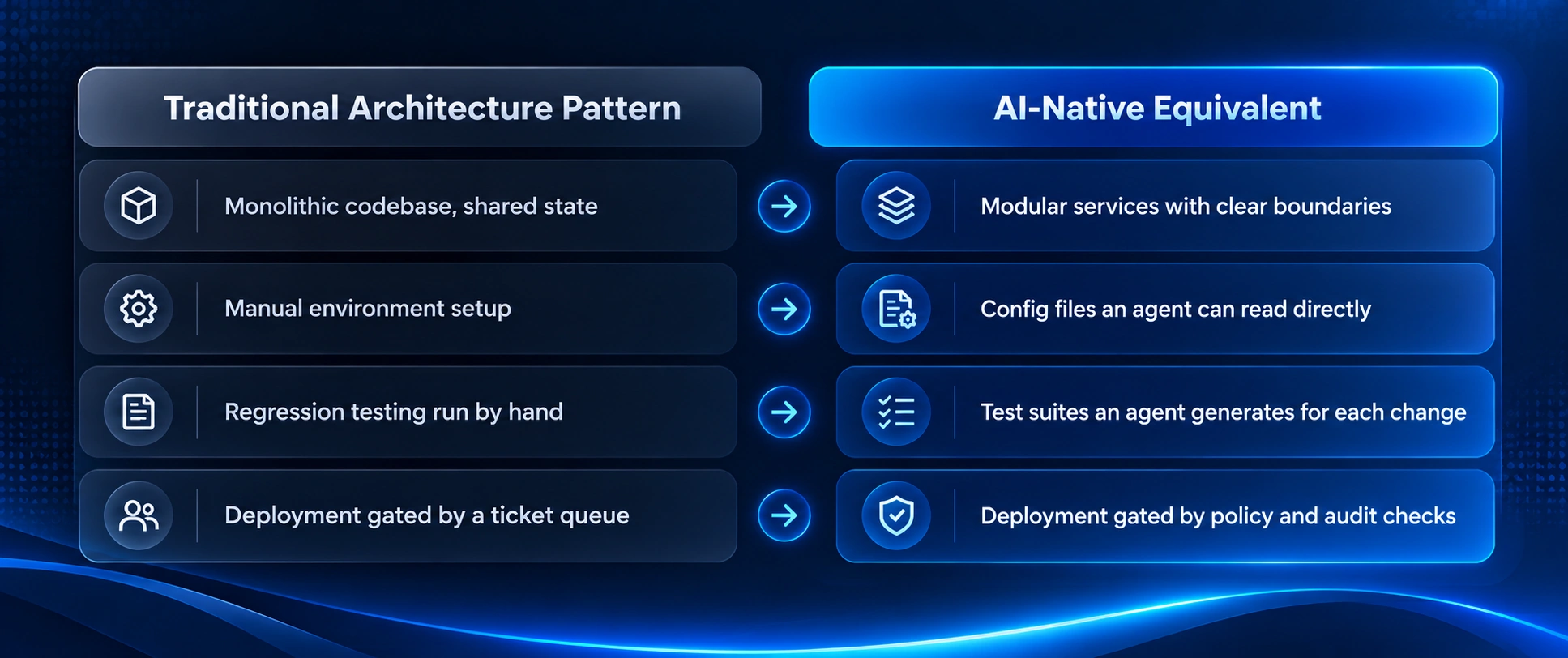
This isn’t a small cosmetic change. A modular, config-driven system gives an agent a bounded, well-defined space to work inside — which is exactly what makes automated testing and deployment safe to run without constant supervision.
Enterprises that skip this groundwork tend to see AI-native development stall at the pilot stage. The agent simply inherits the same tangled code a new engineer would struggle with too. Understanding how enterprise integration architecture supports agent workflows is often the first step teams take before scaling adoption.
Where AI-Native Development Actually Fails Inside Enterprise Environments
AI-native development is not a full swap for engineering judgment. Enterprises that treat it that way run into failures they could have predicted:
==> Legacy systems without clean interfaces — Agents struggle with old, tightly coupled code the same way a new hire would. They just work faster, with less context to fall back on.
==> Compliance-heavy workflows without an audit trail — Regulated teams need a clear record of every decision an agent made. A working output at the end isn’t enough on its own.
==> Vague business requirements — An agent builds exactly what it’s told. A vague or contradictory brief produces vague or contradictory software.
==> No human checkpoint at all — A fully unsupervised agent system, with no approval gate for high-risk changes, creates real security and operational risk.
A side-by-side comparison of agentic and traditional development shows where each model wins, instead of assuming one always beats the other.
The Practical Path Toward AI-Native Becoming the Default Enterprise Model
The direction is already visible in independent research:
==> PwC’s 2025 CEO survey found nearly 70% of global CEOs expect generative AI to change how their company creates and delivers value — within the next three years.
==> OutSystems’ 2026 State of AI Development report found that 96% of surveyed enterprises already use AI agents in some form, with most exploring system-wide agentic strategies rather than small, isolated pilots.
Both findings point to the same trend: enterprises aren’t debating whether to adopt AI-native development — they’re deciding how fast to scale it.
Early movers treat this as enterprise SDLC transformation, not a one-off tool purchase. Their agentic SDLC transition playbook usually looks like this:
- Start with one well-bounded workflow, such as backend generation or frontend scaffolding.
- Prove that governance and audit trails hold up in production.
- Expand scope once those controls are reliable.
Building the Enterprise Case for AI-Native Software Development
The move to AI-native development is not mainly a tooling upgrade. It’s a response to a real gap: the business needs software to change fast, and a ticket-and-queue model moves slow.
Some enterprises still treat AI as an assistant bolted onto an unchanged process. Those teams keep the same bottlenecks they started with — they just move a little faster.
The enterprises pulling ahead are rebuilding the delivery model itself:
==> Modular architecture
==> Agent-run build and test cycles
==> Governance checkpoints that replace manual review without dropping accountability
That’s the practical definition of AI-native enterprise software — built for constant change instead of scheduled releases. It’s also the core of the AI-powered software development approach more enterprises are standardizing around this year.
Conclusion
AI-native development is becoming the default model for enterprise software. The old ticket-and-queue chain simply cannot keep pace with how fast business needs now change.
Enterprises that rebuild around modular architecture, agent-run pipelines, and clear governance checkpoints ship software much faster. Teams still treating AI as an add-on bolted to an unchanged process fall further behind each quarter.
The teams getting this right aren’t choosing between speed and control — both come from the same governed pipeline. That’s the real edge this shift creates for enterprise software teams willing to rebuild around it.
If you’re evaluating your own delivery model, explore how Xccelera’s agentic platform approaches AI-native pipelines to see where a governed, agent-run workflow could fit into your existing stack.